
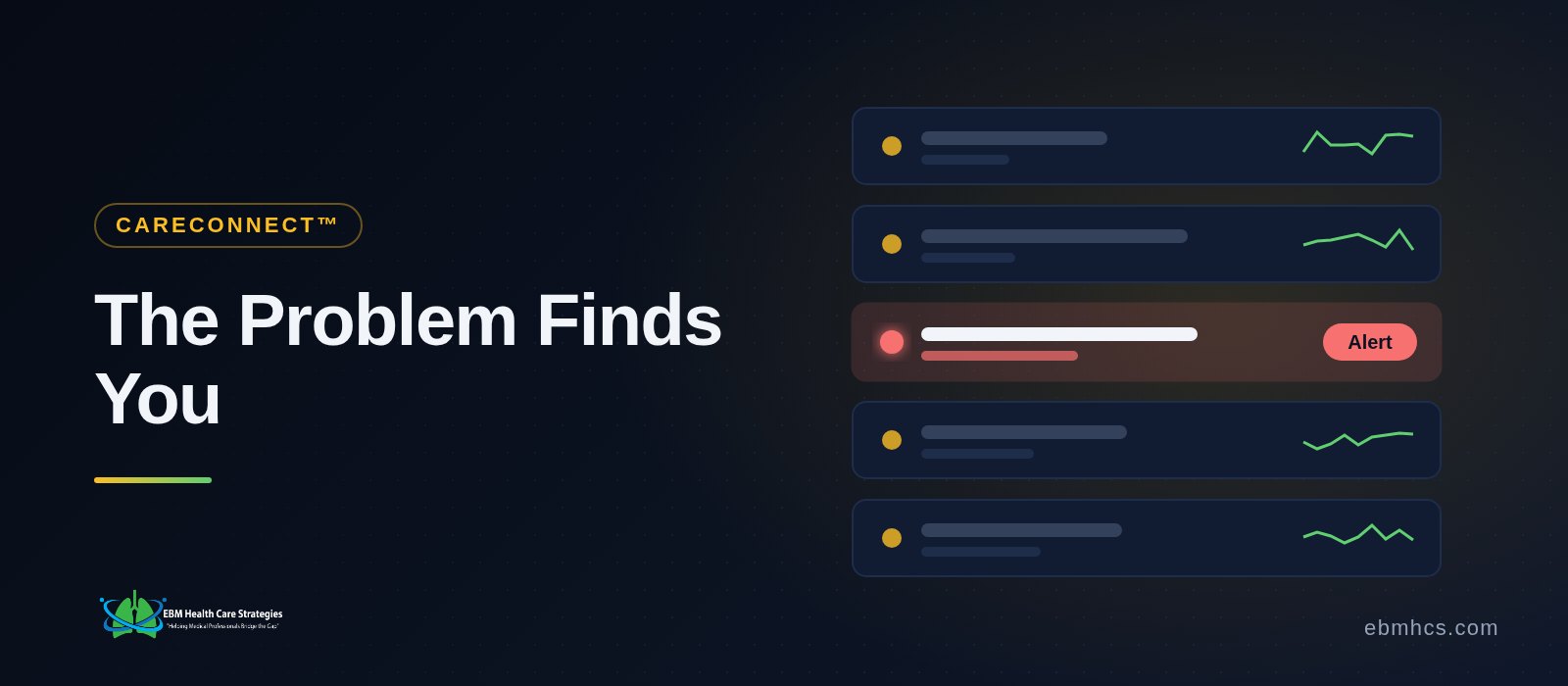
Collecting data from patients between visits is the easy part. The hard part is what happens when hundreds of answers arrive every day and someone has to decide which ones matter.
Many remote monitoring programs quietly fail at exactly this point. The data comes in, it lands in a list, and the clinician is expected to read the list. CareConnect™ is built on a different principle: readings outside a patient’s care plan raise themselves, and the team is never asked to spot the problem in a list.
Why lists do not scale
A list of patient readings looks manageable with ten patients. With a whole chronic population, it becomes a daily chore that competes with every other demand on a clinician’s time. Normal readings far outnumber concerning ones, so most of the effort goes into confirming that nothing is wrong.
That creates two risks. The first is fatigue: a long list is skimmed, and the reading that mattered is missed. The second is delay: if the list is reviewed once a week, a problem that started on Monday is found on Friday. Either way, the point of collecting data between visits is lost.
How out-of-range readings surface
With PDS™ (Patient Data System), each practice decides what it wants to know and builds the questions into a protocol. Each patient’s care plan defines what an expected answer looks like for that patient. When an answer falls outside it, the platform does the sorting:
- Answers arrive in real time, attributed to the right patient, the moment they are submitted.
- Out-of-range readings generate an alert the same day, so the team sees it while it is still actionable.
- Fourteen-day trends sit beside each alert, showing whether it is a one-off or part of a pattern.
- Time spent reviewing and acting is captured automatically as the team works the alert.
The thresholds belong to the care team, not to the platform. Clinicians set what counts as out of range for their protocol and their patients, and they can adjust it as they learn what is useful.
What this changes for the care team
When alerts do the sorting, the shape of the work changes. Instead of reading every answer from every patient, a respiratory therapist or nurse starts the day with the short list of patients who actually need attention. Patients who are stable continue their thirty-second check-ins without demanding anyone’s time.
That is what makes it practical to follow a large chronic population. The work scales with the number of patients who need help, not the number of patients enrolled. It also makes the response faster and more consistent: an alert on the dashboard is harder to overlook than a line in a report.
The response itself stays with the clinician. Depending on the alert, that might mean a message to the patient, a question about whether the therapy is being used, a conversation with the prescriber, or a referral back to the physician. Physicians stay in control; the platform handles the between-visit workload, escalates what needs attention and documents everything. Our page for Health Care Professionals covers how therapists use these tools day to day.
Why it matters after discharge
Same-day alerts matter most when the stakes are highest. In the weeks after a hospital stay, a change in breathlessness or weight can be an early signal that a patient is heading back. For COPD and pneumonia patients, conditions CMS measures under the Hospital Readmissions Reduction Program, an alert that reaches the team the same day is designed to give them a chance to act before an emergency visit.
We cover that window in The 30 Days After Discharge: Where Respiratory Outcomes Are Won or Lost, and the role of trends in spotting trouble early in Catching COPD Exacerbations Earlier with Between-Visit Signals.
Built to reduce work, not add it
The mission of EBM Health Care Strategies is very low-cost solutions that produce measurable improvements in patient outcomes. A platform that adds a daily chore to an already stretched team would work against that goal. Alerts instead of lists are how CareConnect™ produces evidence without producing busywork, and because it deploys with no hiring, no equipment purchases and no IT build-out, the department can start without adding staff to read the data.
See it with your own patient population
We will build a question set for one of your protocols, set it up with your team’s own ranges, and show you which patients surface on day one. Request a demonstration or call (833) 837-8881.