
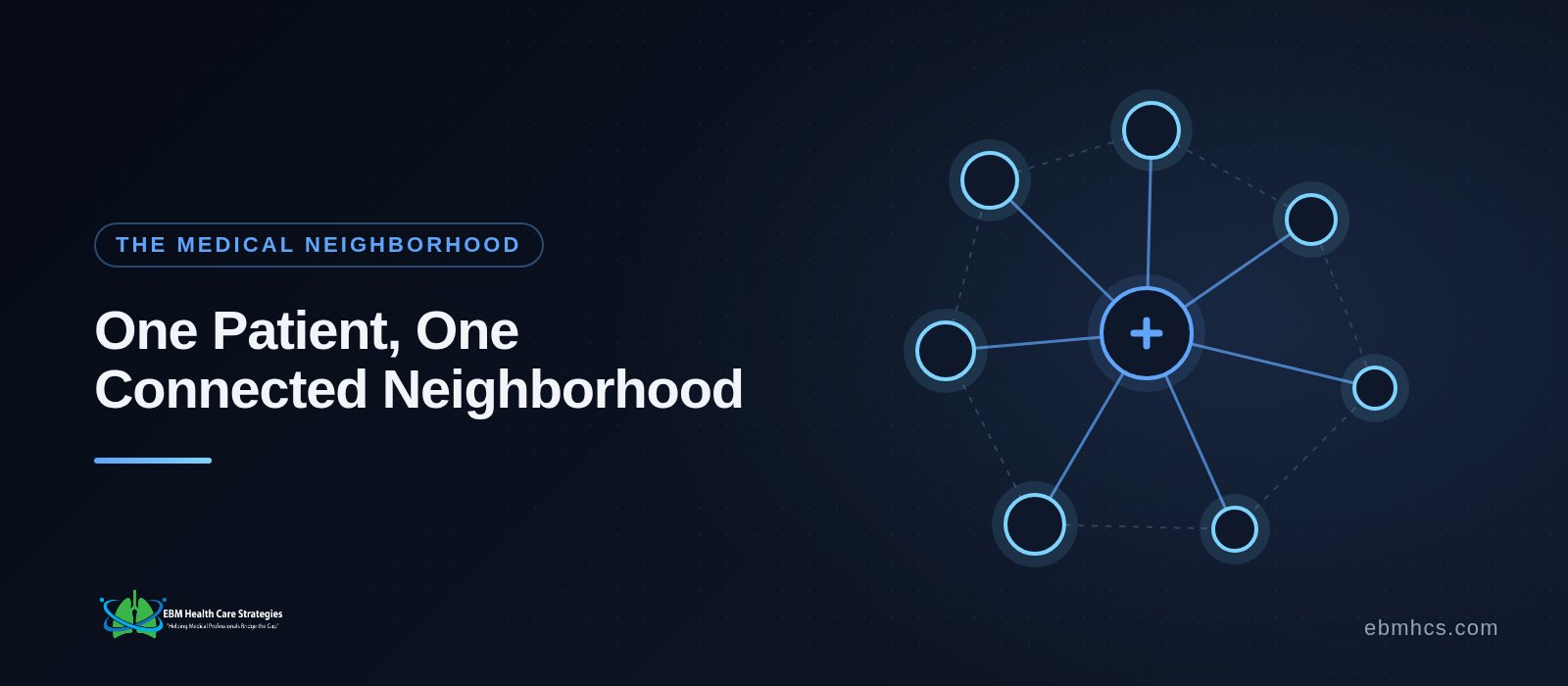
A patient with chronic lung disease rarely belongs to one clinician. The hospital respiratory department treats the flare-up. The primary care physician manages the rest of the chart. A pulmonologist adjusts the inhaled therapy, a cardiologist watches the heart, and a payer pays for all of it. Each sees a slice of the same person, usually at a different moment and through a different system.
The result is a patient surrounded by care but not by a team. Information moves by fax, by phone tag, or not at all. The idea of the Medical Neighborhood is simple: connect the primary care physicians, specialists, health care professionals, hospitals and payers around the patient, so that each one works from the same picture.
Why the respiratory patient falls between the cracks
Respiratory disease is managed in pieces. A discharge summary goes to the primary care office. A device order goes to a supplier. An oxygen prescription is renewed months later by someone who may not have seen the patient breathe since. Each handoff is a place where information can stall.
Meanwhile the patient goes home and lives with the condition every day. Breathlessness changes. Weight shifts. A therapy gets used, or quietly set aside. Between visits, nothing reports back, and every member of the neighborhood is left making decisions from the last snapshot they happened to receive.
A shared record of the days between visits
EBM Health Care Strategies built CareConnect™ to give the neighborhood something it rarely has: a common, current record of how the patient is doing at home. Each practice or department decides what it wants to know. The patient answers those questions on the phone they already carry, one question at a time, in large type, in well under a minute a day.
Those answers land on the care team’s dashboard in real time. Readings outside the patient’s care plan raise an alert the same day, and fourteen-day trends show the direction of travel that a single reading cannot. Because everyone assigned to the patient works from the same record, the hospital, the primary care office and the specialist are no longer reconciling three versions of the truth.
What each neighbor gains
- Hospitals see how discharged respiratory patients are doing in the weeks after they leave, when outcomes are often decided.
- Primary care physicians stay in control of their patients while the between-visit workload is handled, escalated when it needs attention, and documented.
- Specialists get evidence on whether a medication, therapy or device is working, rather than a recollection at the next appointment.
- Payers and accountable care organizations gain continuous data on a population they are financially responsible for.
For the hospital, this matters beyond clinical quality. The respiratory department already engages with a high volume of chronic disease patients who spend almost all of their lives outside the hospital. Connecting those patients to the rest of their neighborhood is a natural extension of that work, and one we describe in more detail for hospitals.
One channel, not another inbox
Connection fails when it adds work. A new portal that someone has to remember to check is not a neighborhood; it is one more silo. CareConnect™ provides a single channel between the patient and everyone on their care team, and between team members themselves. Collaboration happens in one place, attached to the patient it concerns. We explore that design choice in One Channel for the Whole Care Team.
Behind the dashboard is a real licensed health care professional who reviews the data and coordinates with the patient’s doctor. Physicians are not asked to watch a feed. They are told what needs their attention, and the time spent reviewing and acting is captured automatically.
Built to include the whole population
A neighborhood only works if everyone can live in it. PDS™ and Hybrid Overnight Oximetry require no CPT codes, no payer qualification, and place no limits on who can participate by age, diagnosis, symptoms or insurance type. That means a hospital and its partner practices can enroll a whole chronic respiratory population, not a qualifying subset that leaves the rest of the neighborhood disconnected.
It also means the model fits the way care is increasingly paid for. When a hospital, its affiliated practices and a payer share responsibility for outcomes, shared data becomes the foundation of the arrangement. That is the subject of Respiratory Care’s Place in Value-Based Contracts.
There is no hiring, no equipment purchase and no IT build-out required. EBM provides the management platform and the tools, and deploys into the workflows each neighbor already uses.
See it with your own patient population
We will show your hospital and its partner practices how one shared, daily record could connect the clinicians around your respiratory patients. Request a demonstration or call (833) 837-8881.