
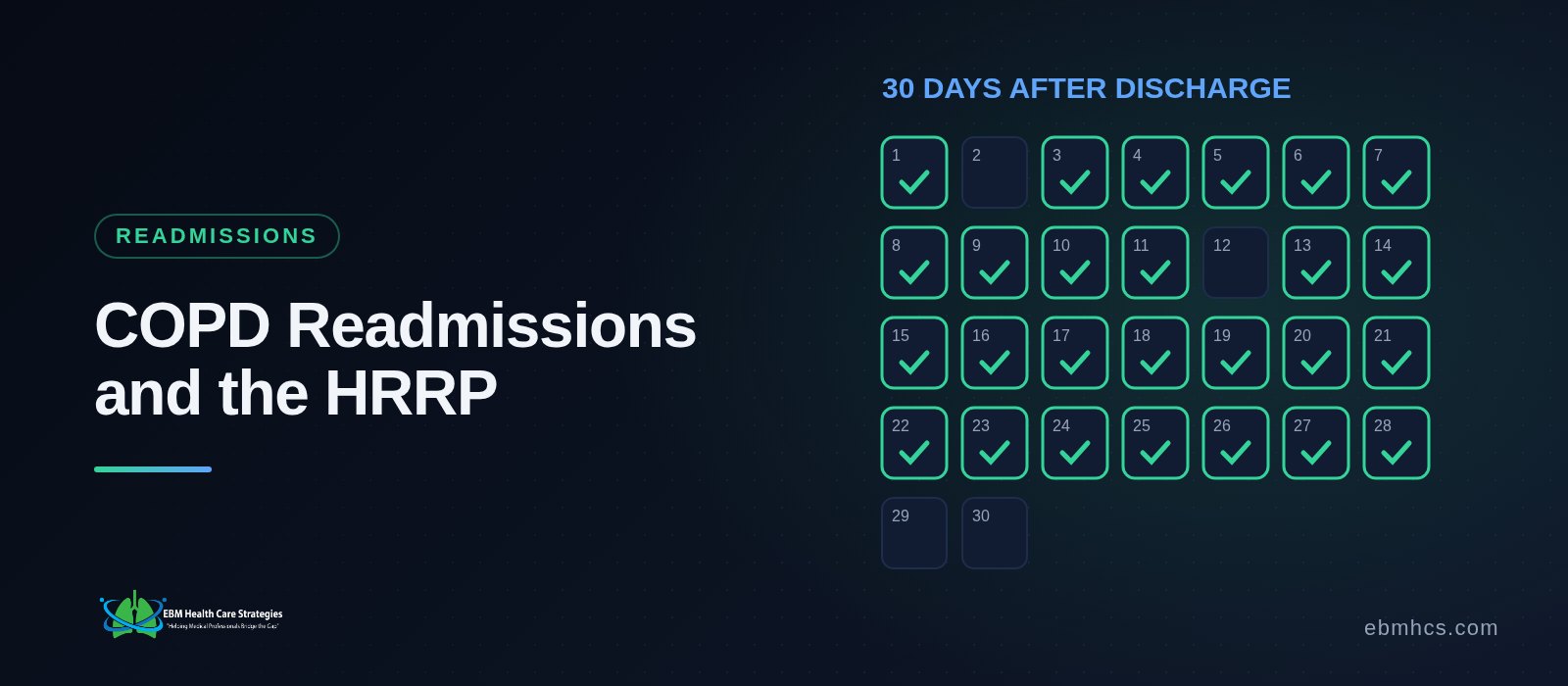
For many hospitals, a COPD readmission is more than a clinical setback. It is a measured event with a financial consequence. The CMS Hospital Readmissions Reduction Program, known as HRRP, tracks how often patients return after a stay for specific conditions and can reduce a hospital’s base Medicare payments by up to 3% when those rates run high.
COPD is one of the conditions HRRP measures, along with pneumonia, heart failure and acute myocardial infarction. That puts the respiratory department close to the center of the issue, even though most of what drives a readmission happens after the patient has gone home.
How the HRRP penalty works in plain terms
HRRP compares a hospital’s readmissions for the measured conditions against what CMS expects. Hospitals with excess readmissions see a reduction applied to their base Medicare payments, up to the 3% cap. The adjustment is not limited to the patients who were readmitted; it applies to the hospital’s base payments more broadly.
For hospital executives, that makes readmissions a quality issue and a revenue issue at the same time. For respiratory directors, it raises a hard question: what can the department do about events that happen weeks after its last contact with the patient?
The visibility gap after discharge
Discharge is where the hospital’s view of the patient usually ends. The patient goes home with instructions, prescriptions and perhaps a follow-up appointment. Between that moment and the next visit, very little reports back.
That gap matters for COPD in particular. Patients may not use an inhaler or oxygen as prescribed. Breathlessness may creep up over several days before anyone notices. A patient may not recognize an early warning sign, or may not want to bother anyone with it. By the time the problem is visible, the patient is often already back in the emergency department.
COPD also rarely travels alone. Company estimates indicate that 11% to 16.5% of Medicare and Medicaid patients have COPD, and that 70% of them also have a cardiac, kidney or metabolic condition. A patient’s return to the hospital can be driven by any of those, which is why whole-patient data is more useful than a single respiratory measure.
What between-discharge visibility looks like
EBM Health Care Strategies closes that gap with daily data from the patient. Using CareConnect™, the care team chooses the questions that matter for a given protocol, such as weight, activity or breathlessness on a scale. The patient answers on the phone they already carry, one question at a time in large type, in about thirty seconds a day.
On the care team’s side, the answers arrive in real time and are attributed to the right patient. Readings outside the patient’s care plan generate an alert the same day, so the team is not asked to spot the problem in a long list. Fourteen-day trends show the direction a patient is heading, which a single reading cannot.
- Is the patient using the prescribed therapy?
- Is it working, based on what the patient reports day to day?
- Is something changing that the physician should know about now?
Those are the questions the program is designed to answer while there is still time to act. We walk through the first month in detail in The 30 Days After Discharge.
Why this model fits hospitals
A readmission program only helps if it can be started. Our hospital programs are built so a respiratory department can begin without hiring, without equipment purchases and without an IT build-out. EBM provides the management platform and tools and deploys into existing workflows.
The program also avoids the usual enrollment friction. No CPT codes are required, there is no payer qualification and there are no limits on who can take part by age, diagnosis, symptoms or insurance type. A hospital can include every COPD discharge, not only a qualifying subset.
Physicians remain in control. The program handles between-visit workload, escalates what needs attention and documents everything, including the time the team spends reviewing and acting on data.
What the program is designed to do
We do not promise a specific reduction in readmissions; results depend on the population and on how the program is run. What the model is designed to do is give the hospital something it does not have today: daily evidence from patients during the period HRRP measures, and a same-day signal when someone needs attention.
For more on recognizing trouble early, see Catching COPD Exacerbations Earlier with Between-Visit Signals.
See it with your own patient population
We will show your team how daily check-ins work for a COPD discharge protocol and what the care team sees when a reading needs attention. Request a demonstration or call (833) 837-8881.