
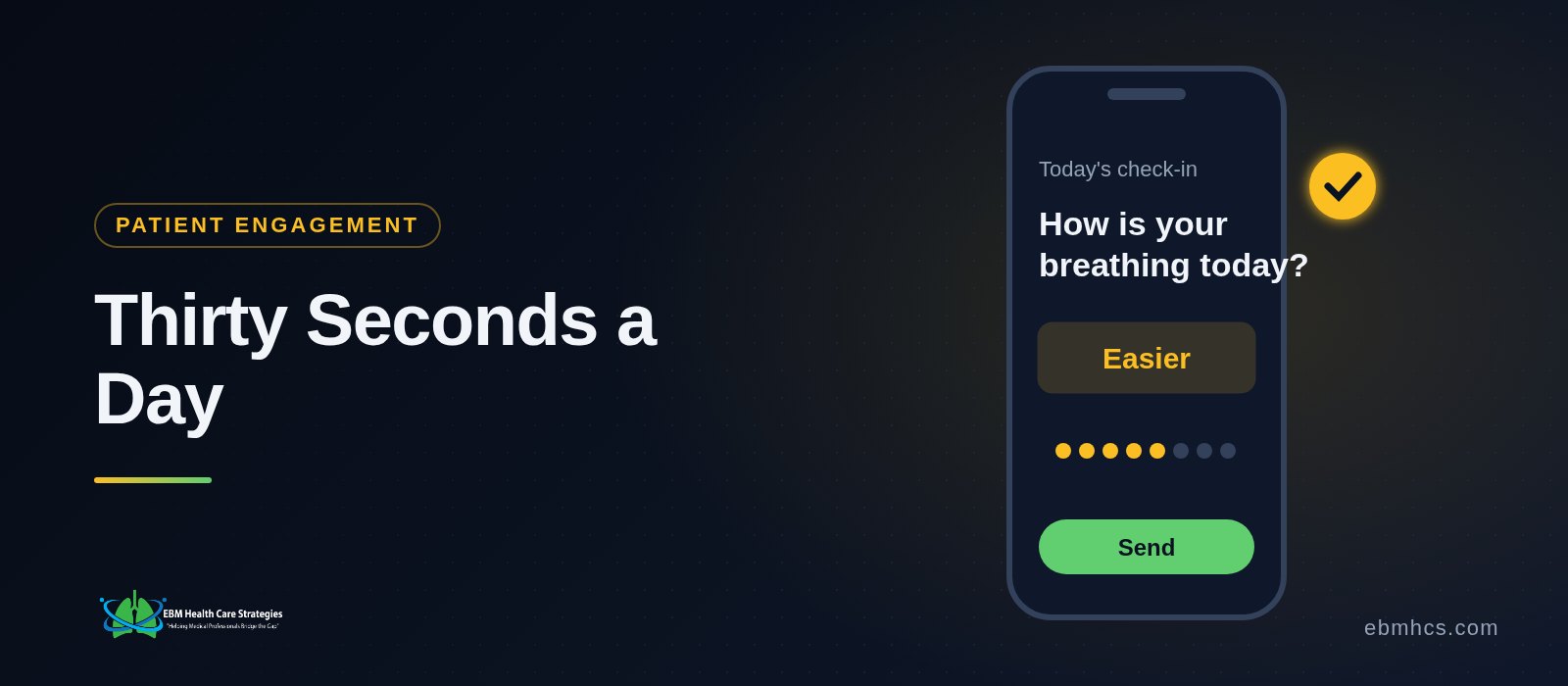
Most remote care programs do not fail because the idea is wrong. They fail because patients stop participating. A device goes back in its box, an app stops being opened, and the data the care team was counting on quietly disappears.
At EBM Health Care Strategies, we designed the patient side of CareConnect™ around one practical observation: engagement happens when the task is small enough to fit into an ordinary day. For most patients, that means about thirty seconds.
Why engagement breaks down
Chronic patients already carry a heavy load. They manage medications, appointments, symptoms and the rest of their lives. Every additional task competes for attention, and a task that feels long, confusing or pointless loses that competition quickly.
Common barriers are well understood: unfamiliar equipment, complicated logins, long questionnaires, and the sense that nobody is looking at the answers anyway. A program that asks for more than a patient is willing to give will collect less data than one that asks for less.
Designed around the patient’s day
The patient experience in CareConnect™ is deliberately minimal:
- The phone they already carry. No new device to learn, charge or return.
- One question at a time. Each screen asks a single thing, so nothing feels like a form.
- Large type. Easy to read for older patients and anyone without their glasses nearby.
- Short by design. About thirty seconds a day, under a minute even on a longer day.
- Only what matters. The care team chooses the questions, such as weight today, steps yesterday or breathlessness on a scale, and sets the frequency based on clinical need.
Those questions come from PDS™, the Patient Data System, which lets each practice decide what it wants to know. We explain how the answers become evidence in PDS™: Turning Thirty Seconds of Patient Answers into Clinical Evidence.
Engagement depends on someone answering back
Short questions solve half the problem. The other half is trust that the answers matter. Patients keep participating when they know a person is paying attention.
With CareConnect™, answers reach the care team’s dashboard in real time. Readings outside the patient’s care plan raise an alert the same day, and a real licensed health care professional, not a robot, reviews the data and coordinates with the patient’s doctor. The patient and everyone on their care team share one communication channel, so a question or concern does not get lost between offices. Our Patients page describes that experience from the patient’s side, and A Real Person Between Visits looks at it in more depth.
Why it matters to the care team and the hospital
Engagement is not a soft metric. Every day a patient answers is a day the care team can see what is happening. Every day they do not is another gap in the record, the same blind spot that exists between visits today.
Consistent participation is what makes the rest of the program work:
- Fourteen-day trends are only meaningful if the data is there to build them.
- Same-day alerts can only fire if the patient answered that day.
- Prescribers can only measure whether a medication, therapy or device is working if the evidence keeps coming.
For hospital respiratory departments, this is where a remote program either earns its place or does not. A program designed for real patient behavior is designed to deliver the continuous data that supports better decisions after discharge and between visits.
Small asks, sustained over time
The most effective engagement strategy is often the least dramatic one: ask a little, ask consistently, and respond when something changes. Thirty seconds a day is easy to dismiss as a small thing. Sustained over weeks and months, across a whole chronic population, it gives the care team what it has never had before: a running picture of how patients are actually doing.
Because the program requires no CPT codes, no payer qualification and places no limits on who can participate, that picture does not have to be limited to a selected few. It can include every patient the protocol fits.
See it with your own patient population
We will show you the patient check-in exactly as your patients would see it, built around one of your protocols. Request a demonstration or call (833) 837-8881.