
A prescriber starts a medication, therapy or device and then waits. The next real look at whether it worked may be months away, and by then the evidence consists mostly of what the patient remembers on the day of the visit.
PDS™, the Patient Data System, is the part of the CareConnect™ platform from EBM Health Care Strategies that changes that. It collects short, structured answers from patients every day and turns them into evidence the prescriber can use to measure the outcome of a treatment and optimize it.
The care team decides what to ask
PDS™ is a Practice-Based Protocol approach. That means the questions are not fixed by the platform; the care team customizes them to the protocol and the patient. A cardiology practice might want daily weight. A respiratory team might ask about breathlessness on a scale. A rehabilitation program might track steps or activity.
The team also sets how often each question is asked. Frequency follows clinical need, not a fixed schedule. Some patients answer daily; others less often. The goal is to collect exactly what the prescriber needs to make a decision, and nothing that adds burden without adding value.
What the patient sees
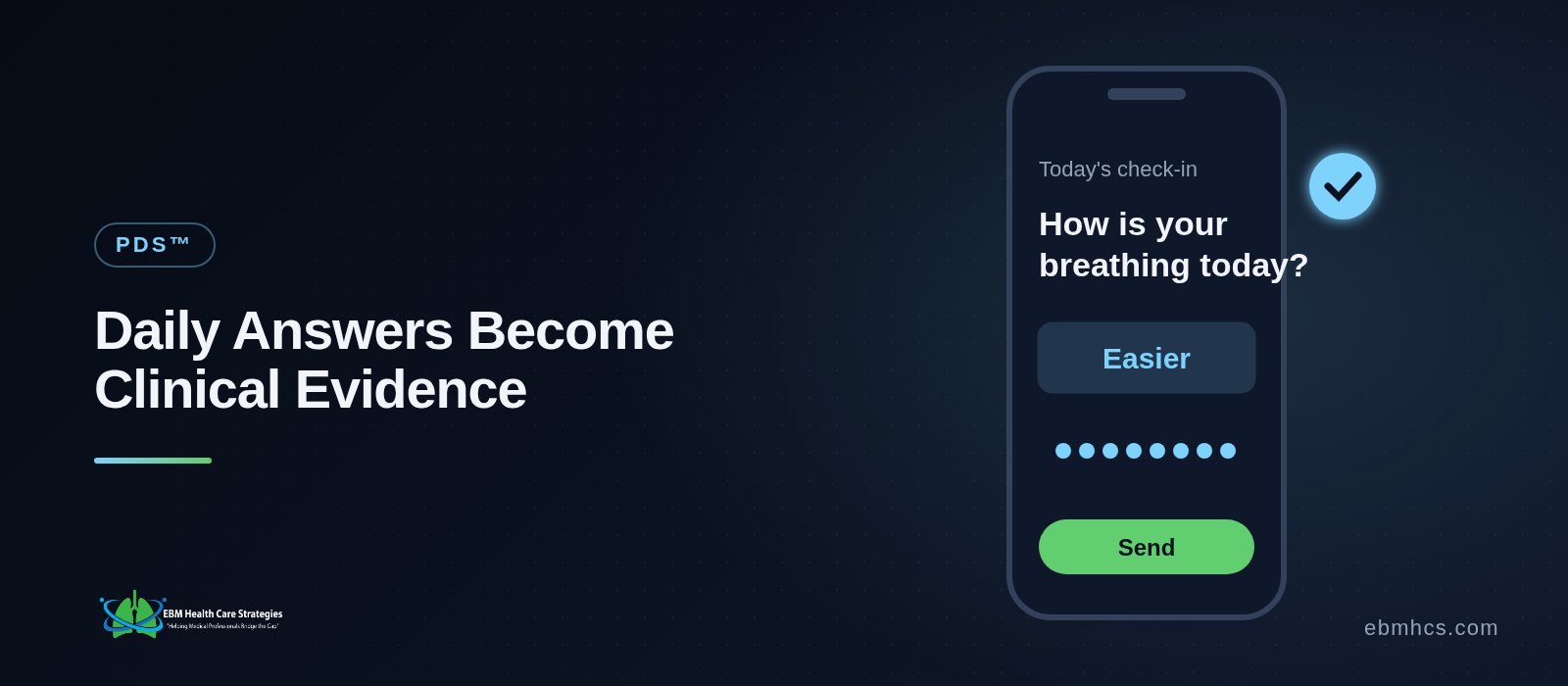
The patient’s side is intentionally small. Patients open the app on the phone they already carry and answer one question at a time, in large type. It takes about thirty seconds a day, under a minute even on a longer day. There is no equipment to learn and no portal to navigate. We describe the design reasoning behind that in Thirty Seconds a Day: Patient Engagement That Actually Happens.
Keeping the task this short is not a cosmetic choice. Evidence depends on consistency, and consistency depends on the task being easy enough to do every day.
From answers to evidence
A single answer is a data point. A series of answers is evidence. PDS™ is built around that difference.
- Real time. Answers land on the care team’s dashboard as soon as they are submitted, attributed to the right patient.
- Same-day alerts. Readings outside the patient’s care plan raise an alert the same day, so the team is not asked to find the problem in a list.
- Fourteen-day trends. Trends show direction and consistency that a single reading cannot.
- Documented work. Time spent reviewing and acting on the data is captured automatically.
The alert design is covered in more detail in Alerts, Not Lists. The principle is simple: the data should surface what needs attention, and the care team should spend its time acting on it.
Measuring and optimizing a treatment
The point of PDS™ is not data for its own sake. It is to let the prescriber answer practical questions with evidence: Is the patient using the therapy? Is it having the intended effect? Is it time to adjust it, continue it or try something else?
Without between-visit data, those questions are answered from a short conversation and a few measurements taken in the office. With PDS™, the prescriber can look at what happened over the preceding weeks and make a decision grounded in the patient’s actual experience. That is what optimizing a treatment looks like in practice: small, informed adjustments rather than long gaps followed by guesswork.
Physicians stay in control throughout. EBM handles the between-visit workload, escalates what needs attention and documents everything. Our Physicians page explains how that division of work operates day to day.
Built to be used broadly
PDS™ requires no CPT codes, no payer qualification and places no limits on who can participate. It is not restricted by age, diagnosis, symptoms or insurance type. A practice or hospital department can apply a protocol to every patient it fits, rather than a qualifying subset, and the cost per patient is a small fraction of what a single office visit reimburses.
That breadth matters for evidence, too. When a protocol is applied consistently across a population, the care team can see patterns that a handful of selected patients would never reveal.
The result is a simple exchange: thirty seconds from the patient, and in return, a prescriber who can see whether the treatment is working.
See it with your own patient population
We will build a PDS™ question set for one of your protocols and show you the evidence it produces. Request a demonstration or call (833) 837-8881.